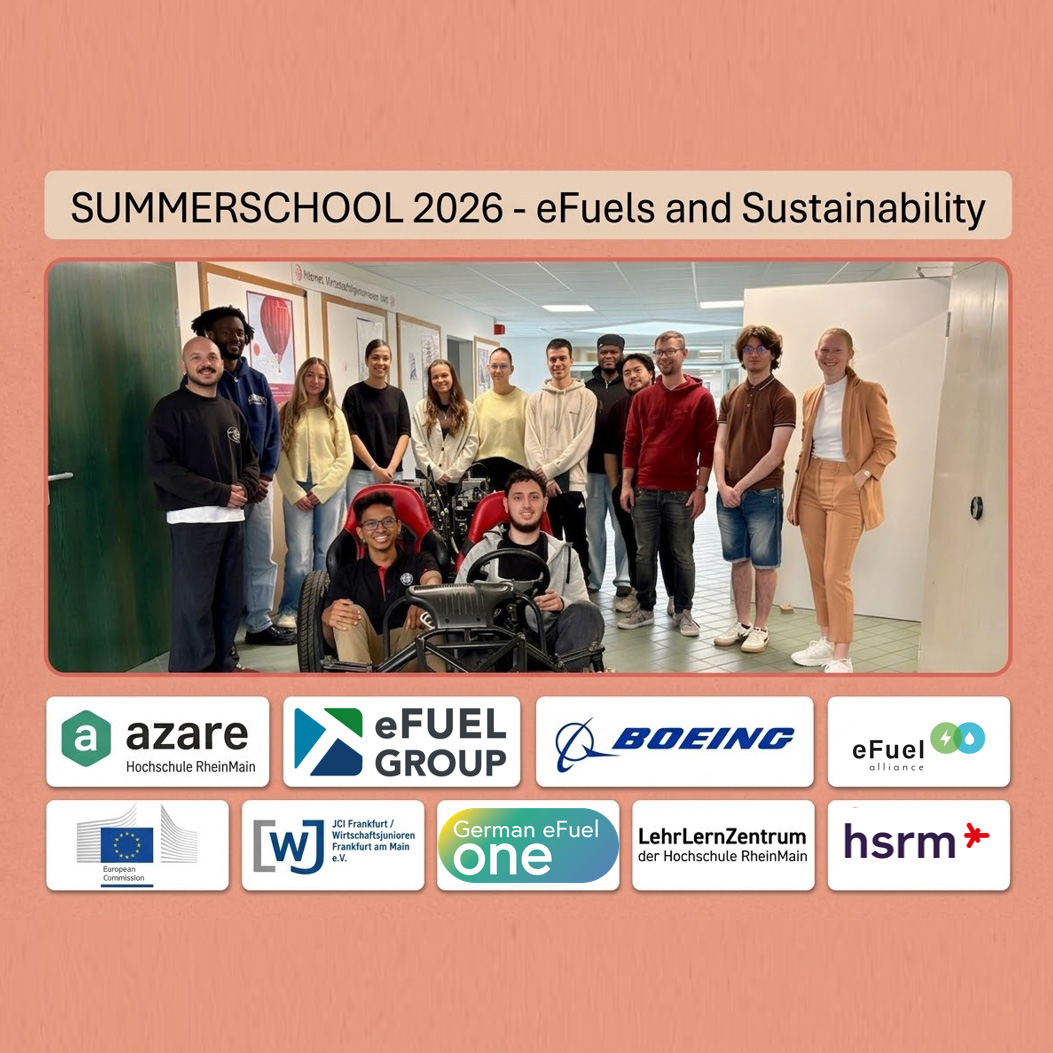
From August 24 to 28, 2026, the “eFuels and Sustainability” summer school took place at Hochschule RheinMain – University of Applied Sciences and Arts under the direction of Maria Wiesmann. For one week, students engaged in an intensive exploration of the production, application, and sustainability of synthetic fuels, as well as current developments in the field of climate-friendly mobility and Sustainable Mobility.
A total of 14 students participated in the summer school. In addition to twelve students from Hochschule RheinMain – University of Applied Sciences and Arts studying Mechanical Engineering, Industrial Engineering and Management, two international students from Malaysia and Georgia also took part.
Diverse, Practice-Oriented Program
The five-day program included a total of:
- six guest lectures by experts from academia, business, and politics,
- two case studies,
- two workshops,
- an excursion to Boeing Global Services and DA Lab Frankfurt,
- a tour of azare’s hydrogen lab,
- an introduction to direct air capture technology,
- insights into sustainability, EU regulations, and Sustainable Mobility,
- as well as a collaborative group project with concluding presentations.
Through the lectures and workshops, participants gained a comprehensive understanding of the technological, economic, and political framework surrounding eFuels. Practical case studies—including the “Haru Oni” eFuel pilot project in Chile and the future of clean mobility—complemented the technical content.
A particular highlight was the excursion to Boeing. There, the students were able to explore current issues surrounding sustainability in aviation and connect the theoretical content of the summer school with concrete applications in practical experience.
Intercultural Exchange and Collaborative Learning
In addition to the academic program, the summer school offered numerous opportunities for intercultural exchange. A scavenger hunt through Rüsselsheim and three group evening events—including a community evening focused on the 17 SDGs—fostered interaction among the students and created a pleasant atmosphere for learning and working.
The students’ feedback was extremely positive. Using a feedback tool, participants particularly praised the varied program, the practical insights, the excursions, and the international exchange.
The 2026 Summer School impressively demonstrated the importance of an interdisciplinary approach to e-fuels and sustainability. The exchange between students, the university, companies, and international partners provided valuable insights and brought current challenges and potential solutions in the field of sustainable energy and mobility systems into sharp focus.
Many thanks to all external partners for their support of the SUMMERSCHOOL 2026, and of course a special thank you goes to the participants: The interactive SUMMERSCHOOL thrives on the valuable contributions and questions provided by all students throughout the week.