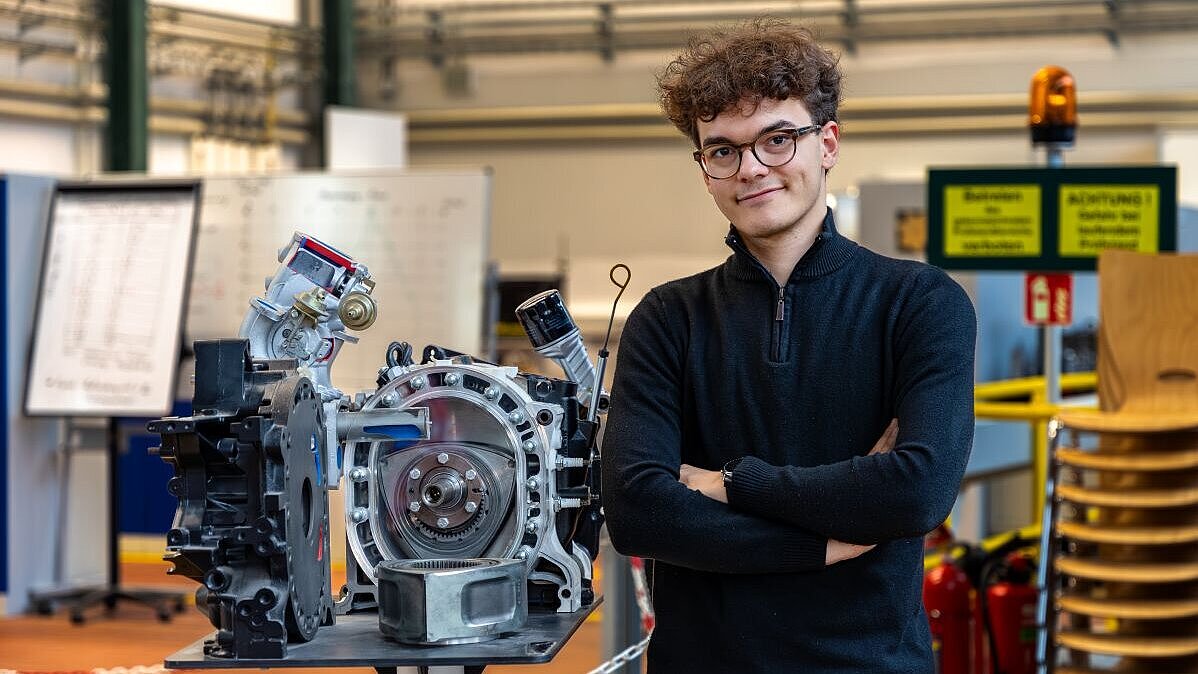
Mr. Novellón Parrilla, you work at Aumovio and are currently in your second semester of the Mechatronics (cooperative program) at Hochschule RheinMain – University of Applied Sciences and Arts. You recently applied for an ada Student Fellowship and were accepted. Can you briefly describe what the ada Student Fellowship is?
The ada Student Fellowship is a continuing education program for students that focuses on important future-oriented topics such as artificial intelligence, sustainability, innovation, digitalization, and personal development. The program combines theoretical content with discussion and practical application. What I find particularly exciting is that you don’t just learn about new topics, but also apply them directly in modules and challenges.
We’ve already had our first introductory meeting, and I’ve started working on a few modules. This gives you a good early insight into the program’s topics and allows you to start applying the material in practice right away.
The ada Student Fellowship focuses on future-oriented topics such as artificial intelligence, sustainability, innovation management, and personal development. Which of these topics interest you the most—and why?
I’m particularly interested in artificial intelligence, digitalization, and innovation management. As a cooperative student in Mechatronics, I work with technical systems, automation, and the integration of mechanics, electronics, and Computer Science. AI will play an increasingly important role in these areas in the future—for example, in intelligent production systems, data analysis, process optimization, and automated decision-making.
At the same time, I think it’s important to view new technologies not only from a technical perspective but also from a responsible one. One of the modules I’ve already started, for example, focused on “Ethics and Technology.” I found the question of why AI systems aren’t neutral—but instead always reflect the data, objectives, and decisions used to develop them—particularly interesting.
The ada Student Fellowship consists of three components: Learn – Meet – Apply—that is, acquiring new skills, interacting with other participants in the ada Student Fellowship, and weekly practical challenges where the new AI skills are put directly into practical experience. What are you most looking forward to?
I’m most looking forward to the combination of exchange and practical application. I find it very valuable to connect with students from different subject areas and backgrounds and, through that, gain new perspectives. At the same time, I really like the practical approach because you don’t just cover new material theoretically, but actually try it out and reflect on it.
In my view, this is especially important when it comes to topics like artificial intelligence: You shouldn’t just know what’s technically possible, but also understand how such technologies can be used effectively and what impact they have on people, businesses, and society.
What do you hope to gain from the program overall for your personal future?
I hope to further develop my professional, digital, and personal skills through the program. For my future, I’d like to combine technical knowledge with forward-looking topics such as AI, sustainability, and innovation.
It’s particularly important to me to learn not only how to develop technical solutions, but also how to critically evaluate them and provide responsible practical experience with them. I also want to strengthen my ability to work in interdisciplinary teams, incorporate different perspectives, and develop new ideas in a structured way. I therefore see the fellowship as an excellent complement to my cooperative degree program and as an opportunity to continue developing myself beyond my studies.
About the ada Student Fellowship
Alejandro Novellón Parrilla has applied for an ada Student Fellowship, a program for STEM students that runs alongside their studies and is funded by the Siemens Foundation. Throughout the program, there are learning modules, events, and community activities focused on future-oriented topics such as artificial intelligence, innovation, sustainability, and mindfulness. Mentoring and challenges are also integral parts of the program.