aPSM-AutoPay
| Project name: | aPSM-AutoPay: Advancing van Westendorp's Price Sensitivity Meter and Investigating Social-Psychological Determinants of Willingness to Pay for Autonomous Mobility Services |
| Faculty: | Architecture and Civil Engineering |
| Head: | Dr. Sebastian L. Grüner |
| External partners: | Prof. Dr. Theresa Herrmann, Ulm University of Applied Sciences |
| Laboratory/Institute: | Rhine-Main Institute for Transformative Sciences in Mobility and Logistics (RITMO) |
| Duration: | 01.03.2025 - 31.05.2026 |
| Funding institution / client: | Hochschule RheinMain – University of Applied Sciences and Arts (HSRM) |
Project description
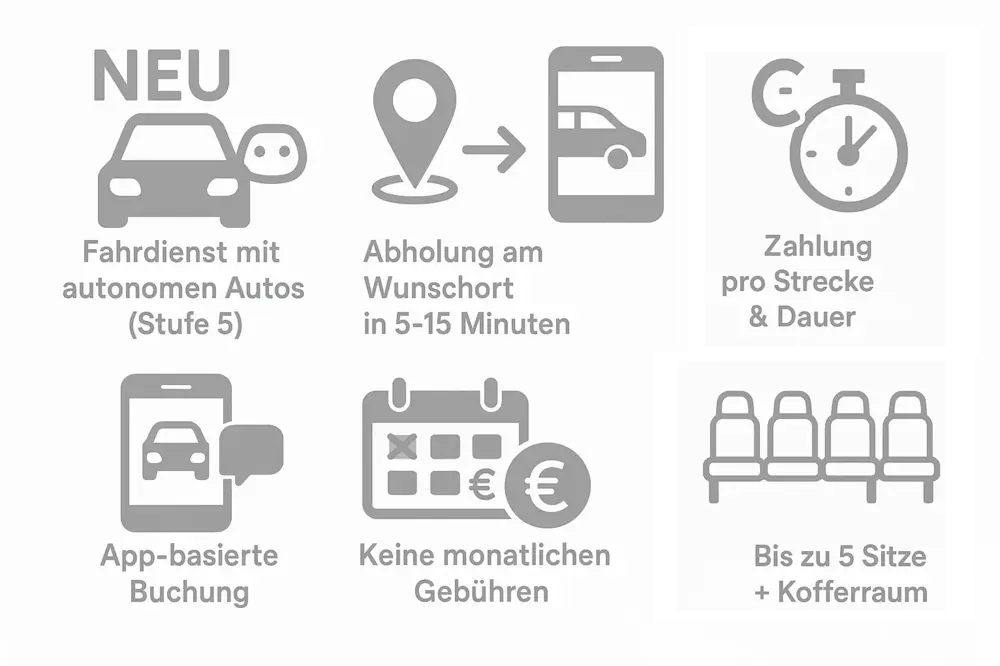
New technologies, products, or services (e.g., autonomous ride services) face challenges related to scaling. While established pricing strategies exist for market entry to influence economies of scale (skimming, penetration, outpacing), the fundamental question ultimately remains that of an optimal price that efficiently matches supply and demand.
Well-known pricing instruments differ in terms of complexity, applicability, and accuracy. Choice-based conjoint analyses (CBC) enable precise price measurement but require extensive datasets. Gabor–Granger price measurements are easy to implement; however, they can only be applied to price increases and require a known reference price. Consequently, many established techniques are not suitable for price estimates of new products.
The Price Sensitivity Meter (PSM) developed by van Westendorp is easy to apply and transferable to new products, while not requiring large amounts of data. Due to that, PSM is used in both practical and theoretical contexts. At the same time, the approach is not free from criticism and is subject to ongoing efforts at further development. The objective of the presented research is a revision of the van Westendorp PSM with application to pooled shared autonomous vehicles (SAVs). By simplifying the instrument, its usability in terms of comprehensibility and data quality is to be improved, with the aim of enhancing applicability and efficiency. An additionally developed structural equation model will examine social-psychological influences on willingness to pay for autonomous ride services.
The quasi-experimental research design aims at a student sample with a size of N=300. To achieve the target sample size, cooperation with Ulm University of Applied Sciences is planned. Students will be approached via an online questionnaire at the beginning of lectures.
The research design comprises a control group and an experimental group. In the control group, willingness to pay is measured using conventional PSM, while the experimental group is measured using the updated PSM. In addition to willingness to pay, sociodemographic data and attitudinal variables are collected to enable further analyses of attitude–behavior relationships.
The project represents a continuation of ongoing research. The pricing instrument to be extended (van Westendorp Price Sensitivity Meter) was applied in three externally funded projects (2022–2024) conducted by the research group for mobility management and mobility behavior. Initial research findings on the topic were presented at the 17th International Conference on Travel Behavior Research (July 14–18, 2024, Vienna) and published in August 2025 in Transportation Research Part A under the title “Investigating willingness-to-pay towards shared e-bikes: A comparison of methods.”
Transfer of results
The research results are to be discussed in a first step at an academic conference (e.g., BRT, EMAC, CARF) and subsequently published both in a German practice-oriented journal and in an international academic journal (e.g., Internationales Verkehrswesen / Research in Transportation Business & Management). In addition to the methodological contribution of the research, the applicability of the results (accounting bases for autonomous ride services, influences on willingness to pay for autonomous ride services) is given equal priority in order to ensure relevance and transferability for industry partners. Upon successful implementation, practitioners will gain access to an easy-to-use and versatile pricing instrument as well as valuable insights into social-psychological aspects of willingness to pay for autonomous ride services.