MIMO Long Range Chipless-RFID Tag Detection and Positioning
Current Research
Our ongoing research advances chipless RFID and MIMO systems through innovative testbeds, cost-effective prototyping, and advanced algorithms.
Key focus areas include:
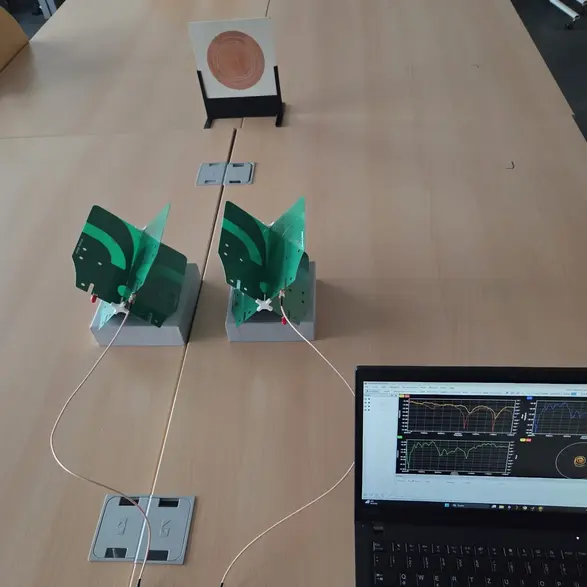
- Indoor MIMO Chipless RFID Testbed: Development of a specialized testbed for MIMO spatial multiplexing utilizing multi-reader spatial diversity and combining detection algorithms to enhance accuracy in complex indoor environments.
- SDR-Based Prototyping: Exploration of software-defined radio (SDR) platforms as affordable alternatives, employing different antennas for stand-alone chipless RFID reader systems that enable rapid development and real-time testing.
- Chipless RFID Tag Design: Promising results achieved with reference notches for improved tag signature clarity; ongoing extension with advanced calibration procedures to improve detection reliability.
- MIMO Detection Algorithms: Investigating and adapting state-of-the-art detection algorithms—including Zero Forcing (ZF), Minimum Mean Square Error (MMSE), and Maximum Likelihood (ML)—for their applicability in chipless RFID systems, aiming to optimize performance in dense multipath channel conditions common in real-world scenarios.
This work enables key advantages such as enhanced detectability, improved reading reliability, increased signal robustness, and greater overall system accuracy. Together, these improvements make possible long-range applications of chipless RFID technologies, significantly broadening their practical use in diverse industrial and IoT environments.


Completed Research Projects:
Our research group has successfully concluded multiple cutting-edge projects in the field of advanced wireless communication and sensing technologies, demonstrating innovation and excellence in both theory and application.
Our key research topics include:
- Chipless RFID System Design
- UWB‑MIMO Communication Systems
- Channel Modeling and System Emulation
These research areas address critical challenges in next-generation communication systems by developing novel detection algorithms, multi-antenna diversity techniques, and calibration methods to improve system reliability in dense multipath environments. Our work exemplifies the integration of theoretical modeling with practical system implementation.
The impact of our research is reflected in three IEEE conference papers, showcasing breakthrough contributions in chipless RFID technology:
- Mohamed El Hadidy and Ines Bakri “MIMO Reader for Chipless RFID Systems Utilizing Antenna Diversity and Combining Techniques” details an advanced MIMO reader design that leverages antenna diversity and combining methods to boost reliability and accuracy in chipless RFID systems.
- Ines Bakri and Mohamed El Hadidy “Chipless RFID Multi-Reader System Utilizing Spatial Diversity and Combining Technique” presents a pioneering multi-reader architecture enhancing robustness through spatial diversity and signal combining techniques, enabling improved tag detection in dense environments.
- Mohamed El Hadidy and Ines Bakri “Enhanced Chipless RFID Detection Algorithm for Dense Multipath Channels based on Calibration Equalization Techniques” introduces an innovative detection algorithm that significantly reduces errors caused by challenging multipath channel conditions using advanced calibration-based equalization.