Widerstand und Klimaanpassung von Dünensystemen
| Project name: | Widerstand und Klimaanpassung von Dünensystemen (Resistance and climate adaptation of dune systems) |
| Project short title: | ResCAD |
| Faculty: | Architecture and Civil Engineering I Hydraulic Engineering Laboratory |
| Head: | Prof. Dr.-Ing. Arne Arns |
| Project participants: | Simon Beckmann, M. Sc. |
| External partners: | State Office for Agriculture and Environment Central Mecklenburg An der Jägerbäk 3 | 18069 Rostock |
| Type of research: | External funding |
| Duration: | 10.2023 - 10.2025 |
| Funding institution or client: | BMBF (PTJ) |
| Funding code | 03F0927B |
| Characteristics of the project | Coastal protection, storm surges, erosion, hydrodynamic modeling, (multivariate) extreme value statistics, |
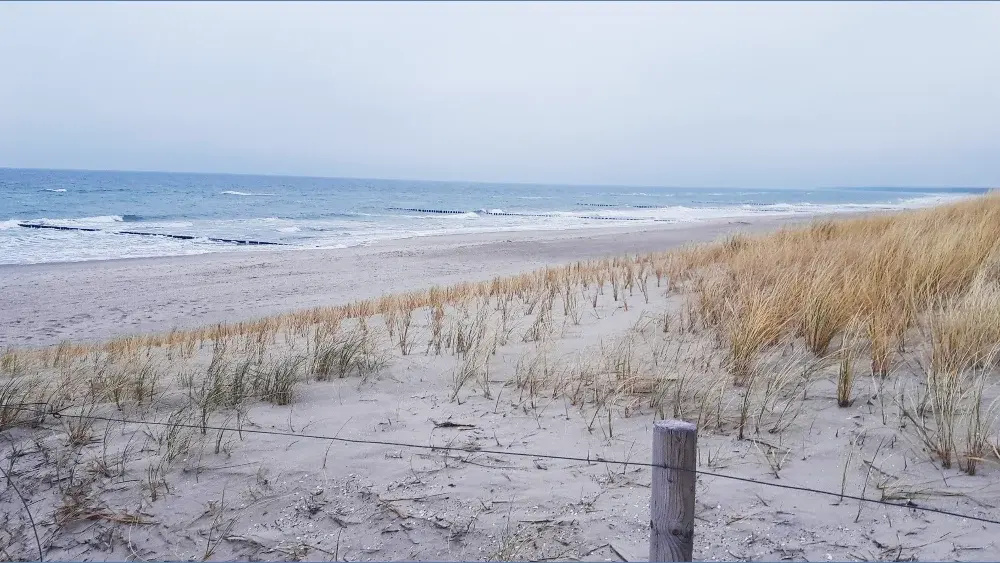
Storms and the resulting flooding are a significant potential hazard on the Baltic Sea coast today as they were in the past. On the German Baltic Sea coast, dunes are the main element of coastal protection. Large parts of the German Baltic Sea coast have been heavily modified by man and only a few areas still have natural dune systems. Due to the inherent dynamics and exposure of dunes to regularly recurring storm surges, they are highly stressed structures. Measures such as artificial planting, beach nourishment and groyne fields are aimed at achieving a morphodynamic balance to ensure the stability of coastal protection.
The rise in mean sea level represents a significant increase in hydrodynamic loads. Erosion and thus the required compensation quantities can therefore increase many times over. In order to achieve the safe, precautionary design and continuous guarantee of the required level of protection with regard to sea level rise, a deeper understanding of the effects of changing, site-specific hydrodynamic loads on the dune body and upstream beaches should therefore be achieved.
Previous approaches to the design of dunes are based solely on empirical approaches, assuming simplified input values. The goal of ResCAD is to describe the non-linear (erosion) processes as an interaction of hydro- and morphodynamics during a storm surge using a numerical, physically based model chain. As a further point, synthetic scenarios are generated using multivariate methods to take into account the possible characteristics of water level and sea state, which should be considered in the design. This represents a significant added value compared to current design practice.
The goal of ResCAD is to provide two interlocking forecasting tools for practical use by authorities and companies as basics for a holistic design concept for dune-protected coastal sections. This corresponds to the following:
- a stochastic storm surge generator for describing/analyzing the hydrodynamic impact side, and
- a statistical dune erosion model for forecasting the erosion volumes on dunes as a result of event-related impacts.