SPP 2255 der DFG „Kulturerbe Konstruktion" ("Cultural Heritage Construction")
SPP 2255 of the DFG „Kulturerbe Konstruktion" ("Cultural Heritage Construction")
| Project name: | SPP 2255 of the DFG "Kulturerbe Konstruktion" |
| Subproject: | Aged High Modernism in Architecture and Heritage Conservation - Analysis of Construction and Materials, Development of Conservation Strategies and Repair Materials for Reinforced Concrete Structures under Engineering and Heritage Conservation Aspects |
| Institute: | Architectural Heritage Conservation degree program/Laboratory for Building Research |
| Faculty: | Architecture and Civil Engineering |
| Head: | Prof. Dr.-Ing. Christoph Duppel, +49 611 9495-1413, christoph.duppel@hs-rm.de |
Project staff:
| Nikolaus Koch, nikolaus.koch@hs-rm.de |
| External partners: | Dr. Michael Auras, Institut für Steinkonservierung e.V., Professor Dr. Bernhard Middendorf, University of Kassel, Institute of Structural Engineering (IKI), Field of Construction Materials and Construction Chemistry, Professor Dr.-Ing. Jeanette Orlowsky, Dortmund University, Faculty of Architecture and Civil Engineering, Chair of Construction Materials |
| Type of research: | Third-party funded research |
| Duration: | 01.01.2021 - 31.12.2023 |
| Funding institution or client: | Deutsche Forschungsgemeinschaft (DFG) |
| Research focus: | Architecture, Engineering, History of Building and Construction, Construction Research, Resource Economics in Construction Building Materials Science, Construction Chemistry, Building Physics |
| Publication form: | Publication |
A three-year research project funded by the Deutsche Forschungsgemeinschaft (DFG) is dedicated to repair methods for concrete structures from the high modernist era. Four types of structures from the 1950s to 1980s are being examined. In interdisciplinary cooperation with the Dortmund University, the University of Kassel and the Institute for Stone Conservation in Mainz, careful approaches are being tested and materials are being developed to create a durable repair method for damaged concrete parts, in particular filigree structures. Hochschule RheinMain – University of Applied Sciences and Arts (HSRM) is contributing its expertise in recording methods and monument preservation aspects to the project, as some of the ultra-modern buildings are already listed and their appearance and construction should not be altered if possible.
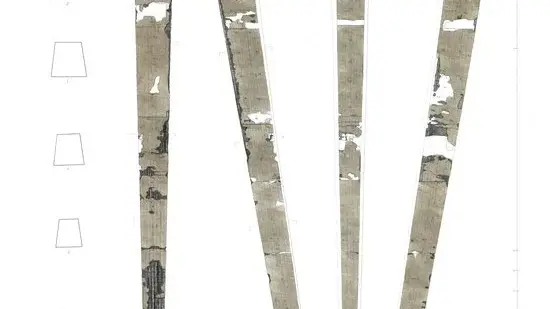
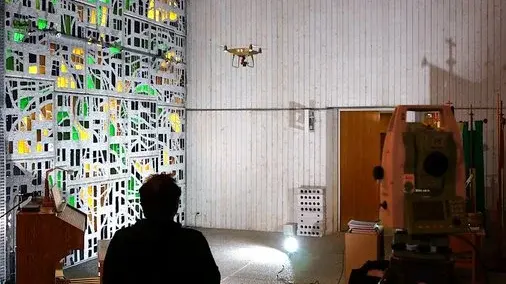
The detailed and deformation-oriented building survey using tachymetry, drone flights and the 'Structure from Motion' method forms the basics for the conceptual design of such restoration measures. In this context, the methods of building research allow a sharper view of the structural, architectural and monument conservation features. For example, it can be essential for the appearance or authenticity of a reinforced concrete structure to take into account traces of workmanship, such as formwork board impressions or the color of the material. These findings are incorporated into the planned measures for the restoration of concrete structures in line with the requirements of listed buildings. A sample application on the selected buildings bridges the gap between the theoretically developed system and its feasibility in practical experience, which is to be accompanied by long-term observation during its ageing process.
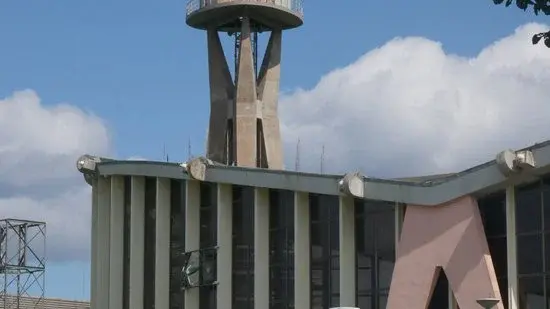
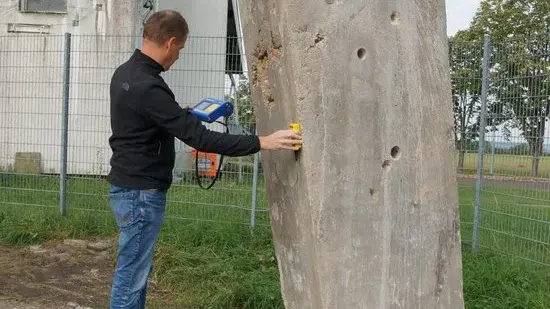
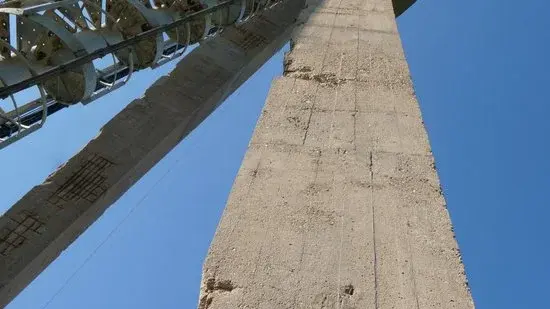
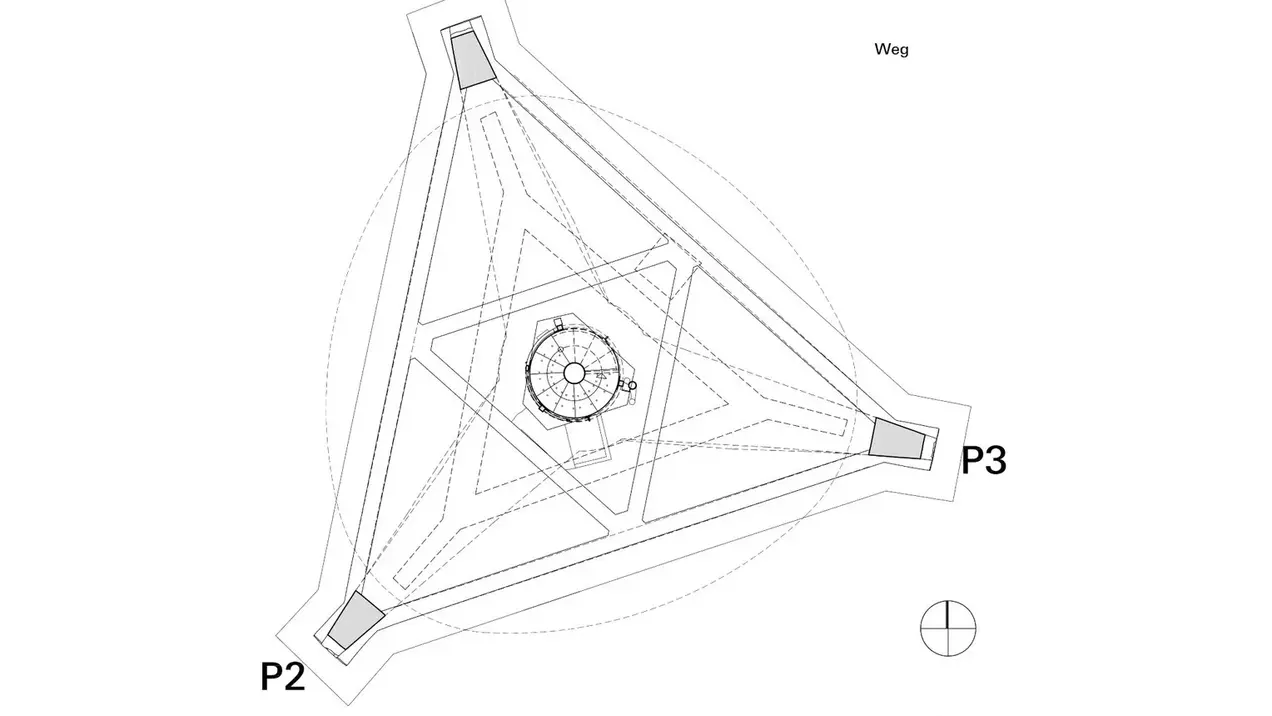
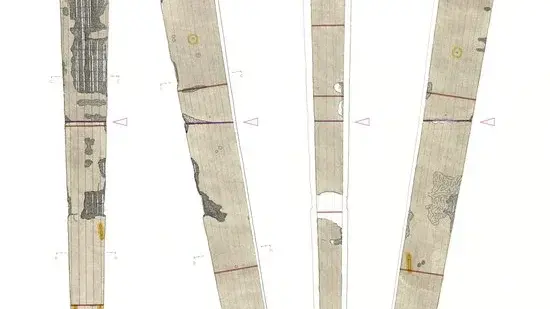
The first object of investigation is located in Überhern-Berus in Saarland. It is the broadcasting station of the French radio station Europe 1. The focus is on the television tower built in 1954 (Fig. 1) - a 35-metre high reinforced concrete structure that appears as a regular tripod with an overlying round platform. The three slender concrete pillars show severe corrosion damage with large areas of concrete spalling, particularly on the inside. The steel reinforcement is already partially exposed. The geometric survey posed a certain challenge in the already scaffolded state, which was solved using photogrammetric recording methods. The subsequent mapping revealed numerous traces of work on the concrete surface, which provided clues to the complex concreting and manufacturing process almost 70 years ago.
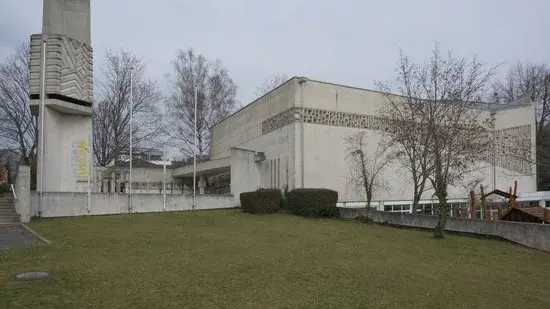
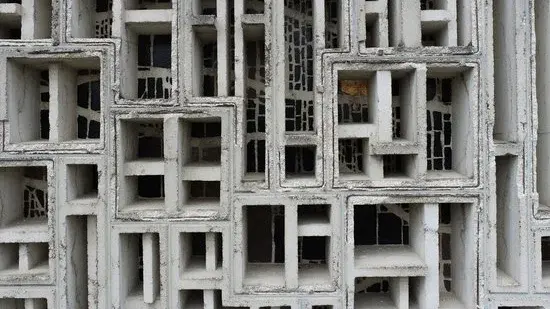
In the second object, the Mauritius Church in Wiesbaden, the specialization is on a filigree and complex concrete window band with inlaid pieces of Dallglas. The specially cast concrete elements made of white cement are unique and show numerous concrete flaking on their webs on the façade. The steel reinforcement is partially exposed.
Archive research was carried out as part of a bachelor's thesis. It shows that during the construction phase of the church in the 1960s, the architect, sculptor and glass artist worked together to design and implement the special window construction. This is where the concept for the restoration began.