UNESCO Chairs Visit Hochschule RheinMain – University of Applied Sciences and Arts
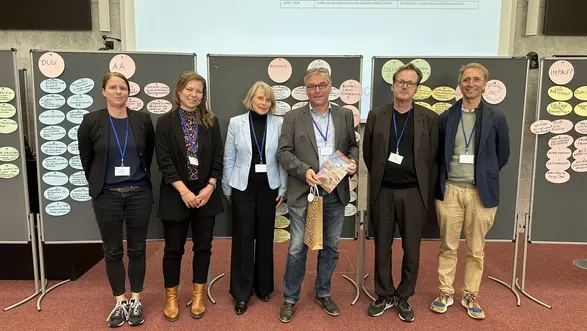
UNESCO Chairs Visit Hochschule RheinMain – University of Applied Sciences and Arts
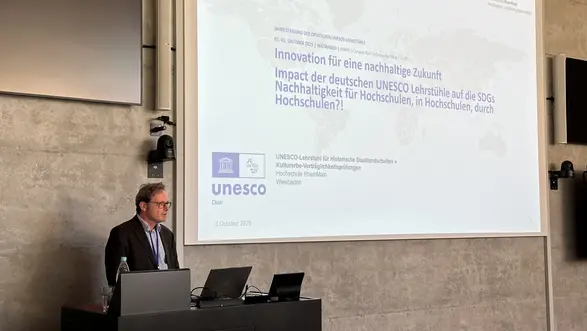
October 15, 2025 - On October 1 and 2, 2025, Hochschule RheinMain – University of Applied Sciences and Arts hosted the annual conference of the German UNESCO Chair Network. The conference was organized by the UNESCO Chair in Historic Urban Landscapes and Cultural Heritage Impact Assessments, led by Prof. Dr. Michael Kloos (Chairholder) and Dr. Merve Demiröz-Torun (Chair Coordinator).
Under the title “Innovation for a Sustainable Future – The Influence of German UNESCO Chairs on the SDGs,” the goal of the conference was to discuss—with a focus on the concept of impact—how universities and the German network of UNESCO Chairs can make a tangible contribution to sustainability in and through higher education.
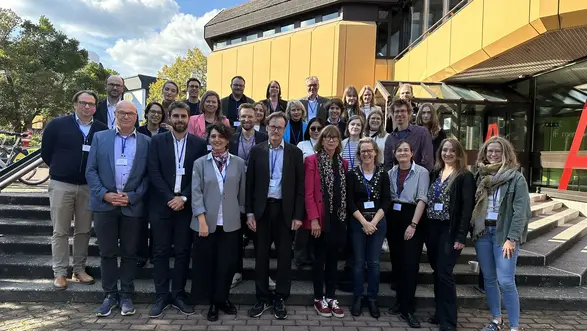
In addition to Friederike Hansell (Head of UNESCO World Heritage Coordination at the Federal Foreign Office) and Dr. Marlen Meißner (Head of the Heritage, Nature, and Society Division at the German National Commission for UNESCO), approximately 40 participants from all 13 UNESCO Chairs at German universities attended.
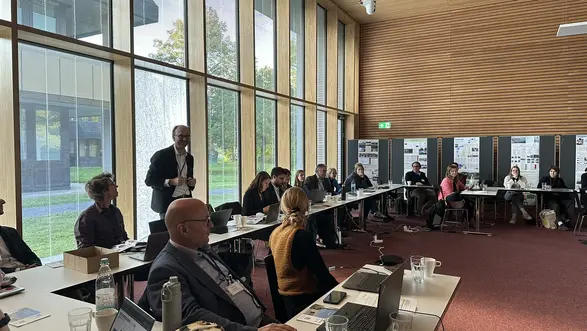
The two-day event began with opening remarks by Prof. Dr. Christian Schachtner (Vice-President for Academic Affairs and Sustainability, HSRM), Prof. Dr. Matthias Kowald (Associate Dean, Faculty of Architecture and Civil Engineering, HSRM), and an introduction by Michael Kloos. The session then explored the collective influence and visibility of the German UNESCO Chairs in promoting sustainability in and through higher education.
The Wiesbaden UNESCO Chair presented its current activities in applied research and teaching, particularly on the topic of impact assessments. In this context, Baharak Ashrafi, a doctoral student at the UNESCO Chair in cooperation with RWTH Aachen University, presented her dissertation, which aims to support sustainable urban development through an integrated approach to impact assessments. As student representatives, Hjördis Dall and Kalle Trappe presented a project from the master’s degree program in Architectural Heritage Conservation | Sustainable Heritage Conservation (M.Sc.) that deals with risk assessments of wind turbines.
Prof. Dr. Thomas Schröder then outlined the plans for the next international meeting in Dortmund (2026), thereby continuing the network’s joint deliberations on the topic of impact. In a series of five-minute “Chair Pitches,” each UNESCO Chair then had the opportunity to present its current approaches and impact with regard to sustainability and the SDGs, providing an overview of the diversity and commitment of the network of German UNESCO Chairs.
Perspectives and Outlook
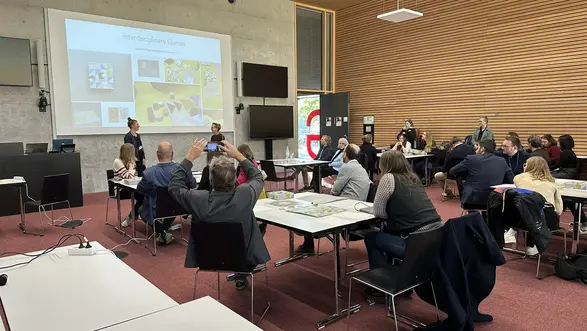
The second day was dedicated to the interdisciplinary game “COLLAB – Postcolonial Teaching and Research,” in which young researchers and student representatives also actively participated in a collaborative game and a discussion on postcolonial perspectives in education and research.
The meeting concluded with a plenary discussion on measuring and communicating the network’s impact and the election of a new spokesperson: Prof. Dr. Julius Heinicke, successor to Prof. Dr. Alexander Siegmund, will share the role for the upcoming term with Prof. Dr. Christine Volkmann.
Overall, the meeting served as an important bridge between last year’s international meeting of UNESCO Chairs in Lüneburg and the next international meeting, which is planned for 2026 in Dortmund and will be attended by UNESCO Chairs from Germany and abroad.