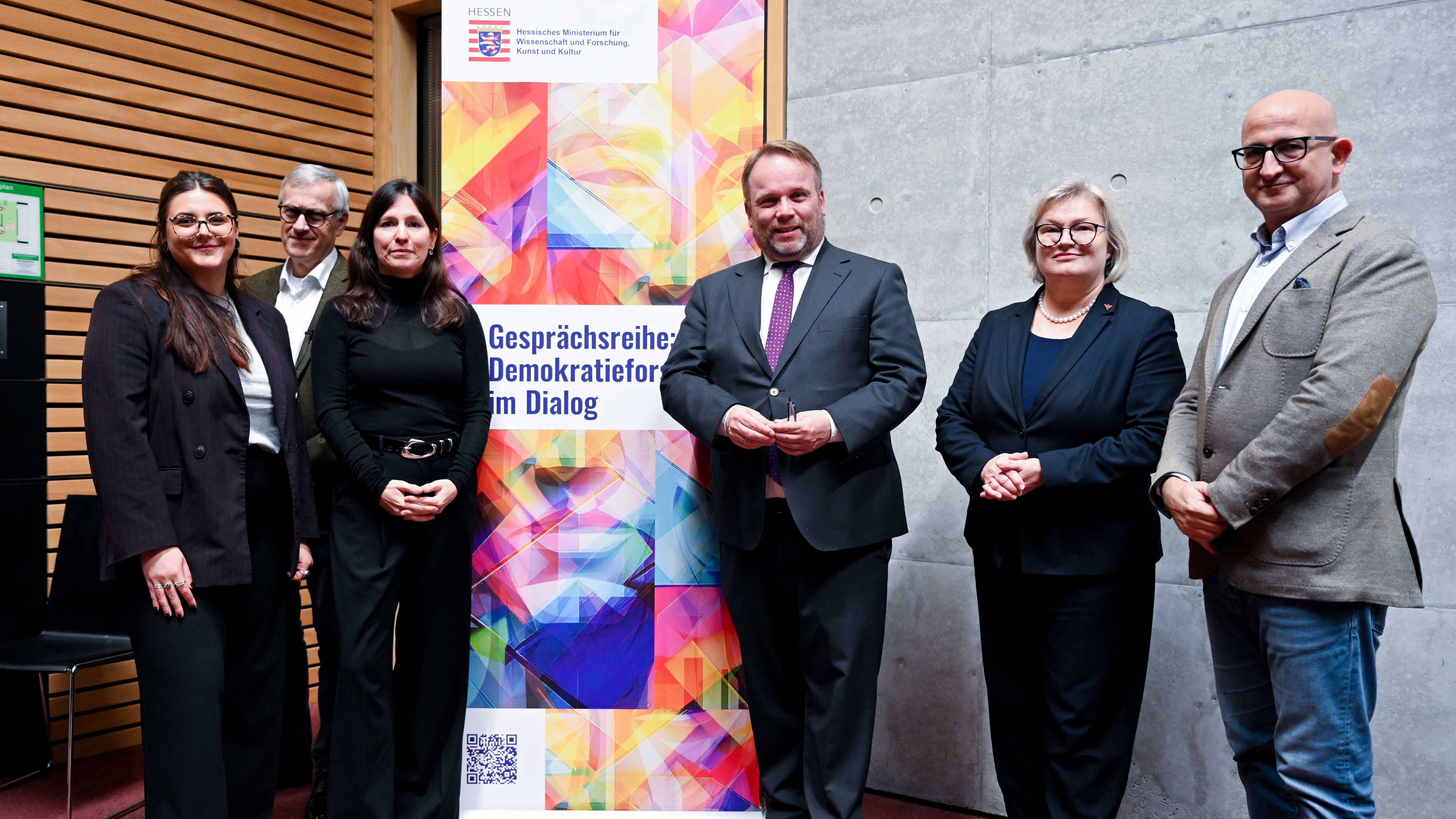
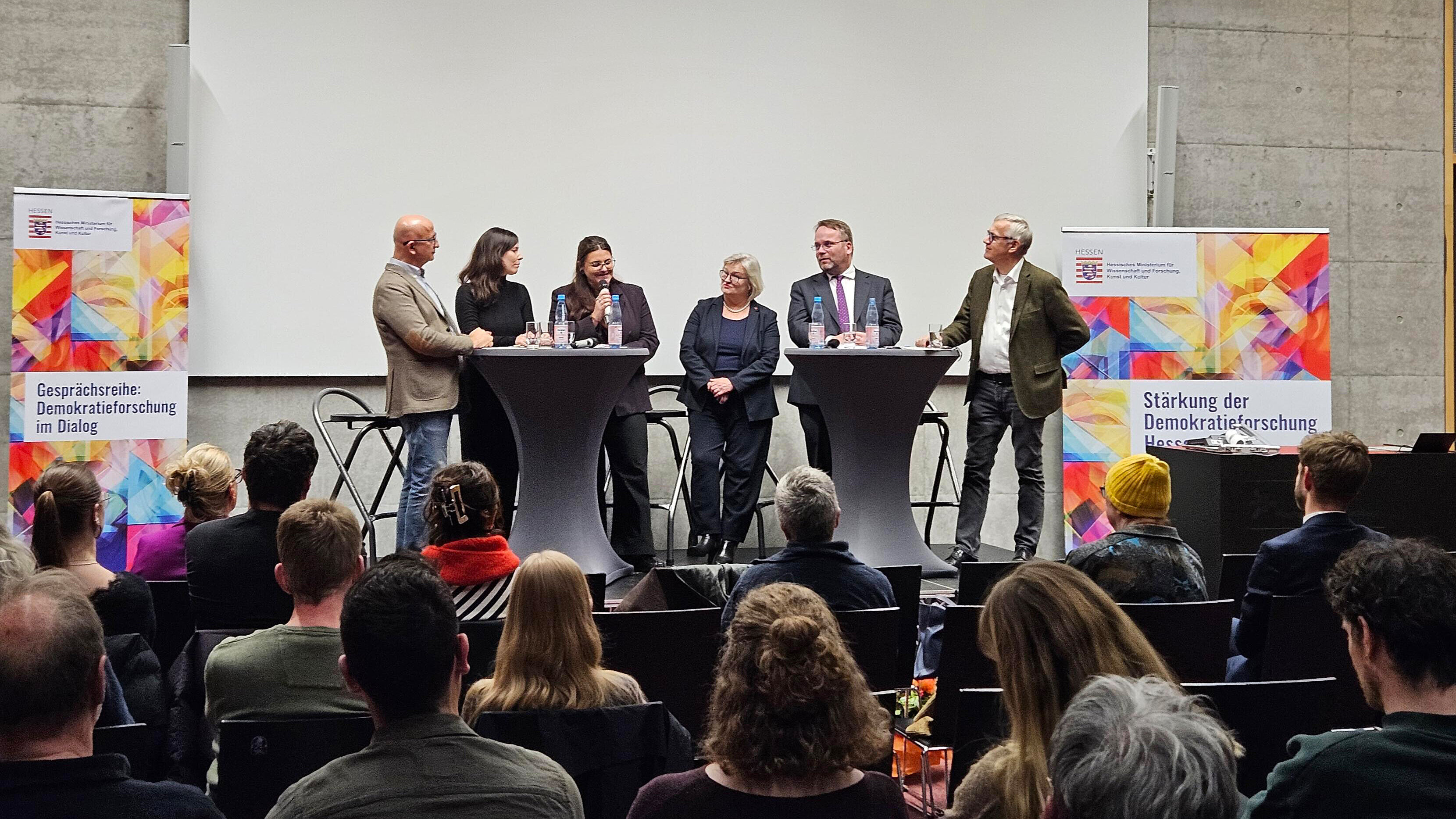
Democracy thrives when people have a say and participate in decision-making. But not all voices are heard equally. Who is involved in shaping decisions, who remains excluded, and how can participation be successful? These questions were the focus of the sixth edition of “Democracy Research in Dialogue,” a series of discussions organized by the Hessian Ministry of Science, which took place yesterday at the HSRM’s Kurt-Schumacher-Ring Campus. Minister of Science Timon Gremmels discussed these issues with University President Prof. Dr. Eva Waller, Dr. Volkan Çıdam, holder of the Paulskirchen Professorship for Democracy Research of the state of Hesse, Prof. Dr. Tanja Grendel from the Faculty of Applied Social Sciences, and Margarete Richter from the EcoAct project group.
Dialogue Between Academia and the Public
“Democracy formally guarantees political equality. However, social, economic, and legal inequalities can prevent all people from actually participating in democratic processes on an equal footing. Democracy research helps us see how participation can be shaped. It serves as a compass in turbulent times, helping us identify the sources of tension, understand how authoritarian tendencies arise, and determine what makes democracies resilient. But research alone is not enough. Scientific findings must have an impact—in politics, education, the media, and civil society. That is why the dialogue between academia and the public is particularly important to me. Hochschule RheinMain – University of Applied Sciences and Arts promotes this dialogue with great dedication,” said Minister of Science Gremmels.
Regarding the importance of universities in democracy, Professor Dr. Waller explained: “Universities are legally established, recognized bastions of democracy. They enable students and staff to experience and practice participation. In this way, universities make an essential contribution to our democratic society as a whole.”
“Democracy is a struggle for inclusion”
Dr. Çıdam taught at the renowned Boğaziçi University in Istanbul until 2025 and has witnessed how democracy is threatened by attacks on academia. He recounted how he, together with students and other faculty members, resisted the government’s interventions under President Recep Tayyip Erdoğan. “Democracy is a struggle for inclusion. Every democratic debate is therefore also a struggle to define the demos: who receives recognition as an equal among equals, and who is included in the circle of political equals. This definition not only determines the normative objectives of democracy but is also reflected in its political forms of organization,” said the holder of the Paulskirchen Professorship for Democracy Research, who is teaching and conducting research for one year in the Faculty of Applied Social Sciences at HSRM.
“Strengthening Democracy Research in Hesse”
The newly established Hessian Paulskirchen Professorship for Democracy Research is part of the “Strengthening Democracy Research in Hesse” program. Also part of the program is the project “Diversity-Sensitive Evaluation of the City of Wiesbaden’s Framework Concept for Youth Participation” (DiValuation), in which researchers are evaluating Wiesbaden’s framework concept for youth participation. Project leader Prof. Dr. Grendel spoke about the perspectives of young people, how they experience democratic self-efficacy in participatory formats, and how young people who have not yet been reached can be targeted more effectively.
Margarete Richter from the HSRM’s EcoAct project group also demonstrated how social media, artificial intelligence, and new forms of interaction can engage young people in democratic processes.
About the Discussion Series
The discussion series organized by the Hessian Ministry of Higher Education, Research, Science and the Arts brings together academia, politics, and citizens. The aim of this exchange is to promote the democratic free exchange of ideas, to introduce citizens to science, to highlight the diverse landscape of democracy research in Hesse, and to foster connections between academia and society.
Press release on the Paulskirche Professorship for Democracy Research