13 Ideas, 3 Project Tracks, 1 Board: EIS@HSRM Brings Ideas to Life
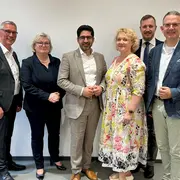
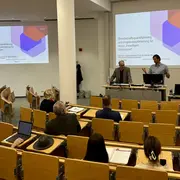
The meeting of the Educational Innovation Board (EIB) was entirely focused on the first round of applications: With the mailing of the grant approval notices, the next phase of EIS@HSRM begins, and 13 innovative ideas from various faculties can now move into the implementation phase. The funded projects range from AI-supported teaching formats and open learning and innovation spaces to interdisciplinary project weeks and digital excursions.
Creating space for sustainable initiatives to further develop teaching and learning remains the project’s guiding principle. This commitment is tangibly brought to life through renewal applications for pilot projects that have already been successfully launched, as well as new projects focused on a wide range of innovations.
Overview of Funding Decisions from the First Round of Applications
In total, the following projects were approved for funding:
Faculty of Design Computer Science Media
AI Studio for Communication Design: a model-agnostic makerspace for the practical application of generative image, video, and text systems, as well as the development of a transferable teaching kit for other degree programsFab Lab for Media Computer Science: Develops a learning and innovation space open even outside of regular classes, featuring Open Lab Days and a student peer-learning platform to promote interdisciplinary projects, student-led initiatives, and sustainable exchange.Living Material Lab: is developing two consultation rooms in the TeachingLearningCenter as reversible “Campus as Living Lab” prototypes, where students can practically test sustainable materials, smart environmental monitoring, and health-promoting spatial concepts.Open Workshops: Expands the open workshop to provide interdisciplinary access to workshops, a photo studio, and digital model-building technology for students in interior architecture, Communication Design, and Media Management.
Faculty of Engineering
Challenge Week: An interdisciplinary, hands-on project week in which Engineering students collaborate to tackle relevant challenges, strengthen their future skills, and publicly present their results.Future Conference 2027: Industrial engineering students design a one-day conference on AI-driven changes in the world of work in collaboration with corporate partners; through organizing the event, they further develop their organizational and negotiation skills and refine the format compared to the 2026 edition.SMF Project Lab: A cross-semester model for technical project-based learning in which students document, reproduce, and further develop existing software and microelectronics projects.Makerspace LAP: maintains an open, interdisciplinary learning space where students receive guidance in implementing their own ideas using modern manufacturing processes and develop practical skills and self-efficacy through peer learning.Lytris: tests an AI system developed for university-level mathematics instruction that supports students in independent learning through teaching-material-based explanations, personalized tutorials, and interactive visualizations.
Wiesbaden Business School
AI Fluency: Establishes AI-assisted learning support in marketing courses and develops a structured prompting playbook as an open educational resource to empower students to use AI in a reflective and independent manner.Academic Podcast: professionalizes the “Health Up” podcast as a practical examination and teaching format by providing students with access to the necessary podcasting technology and enabling them to independently adapt academic content to suit specific target audiences.
Faculty of Architecture and Civil Engineering
FAB-MakerSpace: is expanding a freely accessible resource center and a materials library for sustainable building materials, enabling students to independently select and test materials and take advantage of complementary workshop and advisory services.DigiX: Develops a library of digital excursions featuring 360° imagery, providing students with cost-effective, flexible access to real-world locations and expanding the faculty’s range of excursion offerings.
Effective immediately, the projects approved by the board will not only be supported by funding but will also receive guidance from the Educational Innovation Office (EIO) in planning, implementation, and networking.
“The selected projects demonstrate the diversity of approaches to the teaching and learning experience at Hochschule RheinMain – University of Applied Sciences and Arts. It is important to us that these projects do not merely result in temporary, isolated initiatives, but rather generate momentum that will have a long-term impact.”
Dr. Petra Kreis-Hoyer, Head of Division V – Studies and Teaching
With this encouraging diversity of topics and the number of project ideas submitted, the first round of EIS@HSRM applications sends a clear signal about the innovative strength at Hochschule RheinMain – University of Applied Sciences and Arts. The funded projects thus create concrete opportunities to test innovative approaches in teaching, gain experience, and potentially institutionalize successful formats in the long term.
“Teaching must be an experiential process; teaching must inspire. This is precisely where many of the projects we fund come into play. They spark curiosity, focus on cross-media and cross-program instruction, and result in tangible progress in teaching.”
Lucas Kraus, student EIB member & EIB vice chair
What’s Next: Prospects for EIS@HSRM
The next call for applications is scheduled to begin in spring 2027. Information regarding application deadlines will be posted on the EIS website in a timely manner.
Anyone interested in discussing EIS@HSRM or contributing ideas for future application rounds is cordially invited to contact the project team via email at eis@hs-rm.de.