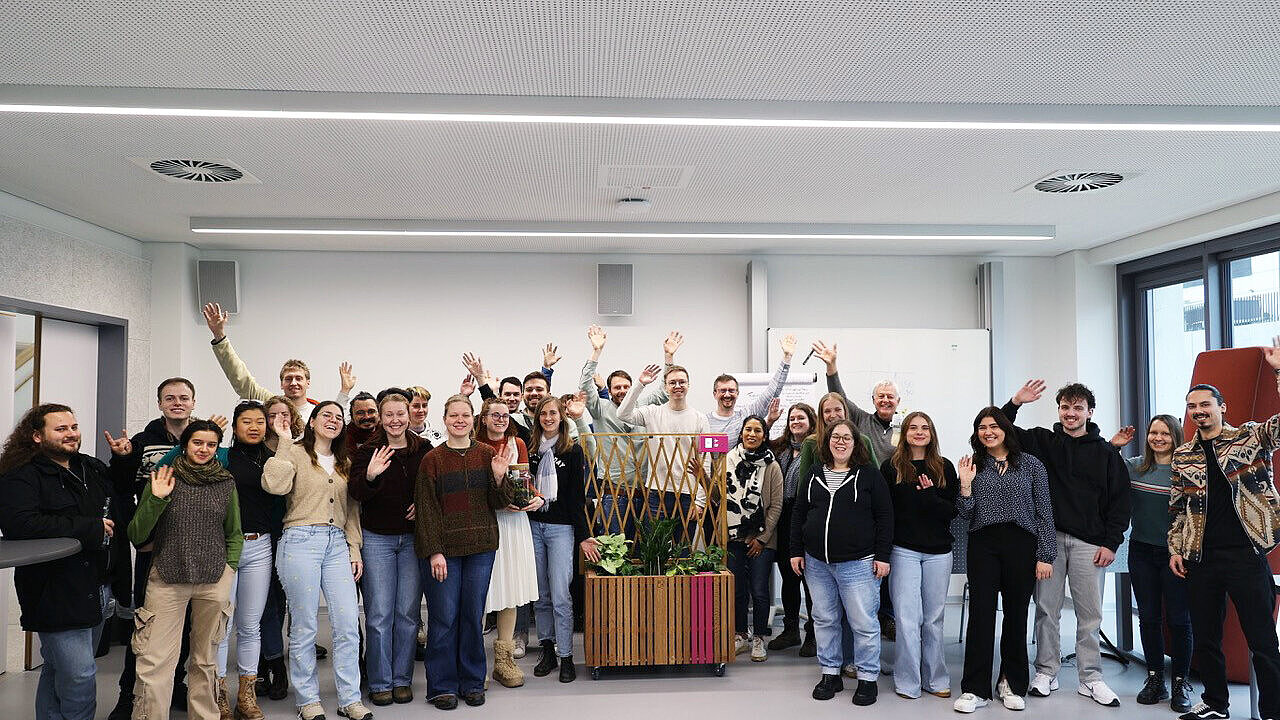
Three degree programs, two universities, one goal: smart, sustainable, AI-supported indoor greening. The SNIB - Smart Sustainable Indoor Greening project involving the Media Management and Business Informatics degree programs (Hochschule RheinMain) and the Special Plant and Horticultural Sciences and Horticulture degree programs (Hochschule Geisenheim University) has been successfully completed after two semesters. The results of the project were brought together at a workshop in the TeachingLearningCenter (LLZ) of Hochschule RheinMain (HSRM). Students from Hochschule Geisenheim University presented future concepts for indoor greening.
"In the first semester of the project, selected plants from Hochschule Geisenheim University were installed in planters and equipped with sensors and a camera in the computer science building on HSRM's Unter den Eichen Campus. The goal was to record environmental parameters such as soil moisture, light and temperature and to develop a data-based irrigation and care concept on this basis," explains Dr. Maren Stollberg from Hochschule Geisenheim University. The data collected was processed using a specially developed data management system and formed the basics for a prototype smart plant installation. A microcontroller records the sensor data and transmits it to the HSRM server. Current values and recommendations for action are visualized on an e-paper and a display as well as on a website developed by Media Management students.
As the project progressed, the sustainable planter was further developed both conceptually and technically. "The sensor data flows into a specially implemented AI model based on open source technologies, which evaluates the condition of the plants and derives specific recommendations for action," says Professor Holger Hünemohr from HSRM's Business Informatics degree program.
The planter has now been installed in Building L on the Kurt-Schumacher-Ring Campus, where it is helping to improve the indoor climate and enhance the quality of stay and communication. Students on the Media Management degree program provided communication support for the project, developed the project website with live data and AI visualization and documented the progress on film and via social media. The goal is to arouse interest in sustainable, technology-based solutions in line with the global sustainability goals.
Smart division of labor for joint success
The disciplines involved at the two universities worked closely together: While horticultural concepts for suitable plants and greening scenarios were developed, Computer Science students implemented the technical infrastructure for data collection and evaluation. The Media Management students designed the communication and multimedia presentation of the project.
"The project is an example of how technological solutions, scientific analysis and creative communication can work together to develop sustainable learning and working environments," says Prof. Dr. Johannes Luderschmidt from the Media Management degree program.
Future of the project in interior design
In the Living Materials Lab of the Interior Architecture degree program at HSRM's Unter den Eichen Campus, the research results of the SNIB project will be taken up in the coming summer semester and integrated into an experiential materials library for regenerative interior design. Material and plant systems are to be further developed with sensor technology and AI-supported monitoring. The goal is to record indoor quality in a measurable way and to use the plant system sustainably as a basis for life-promoting design approaches.