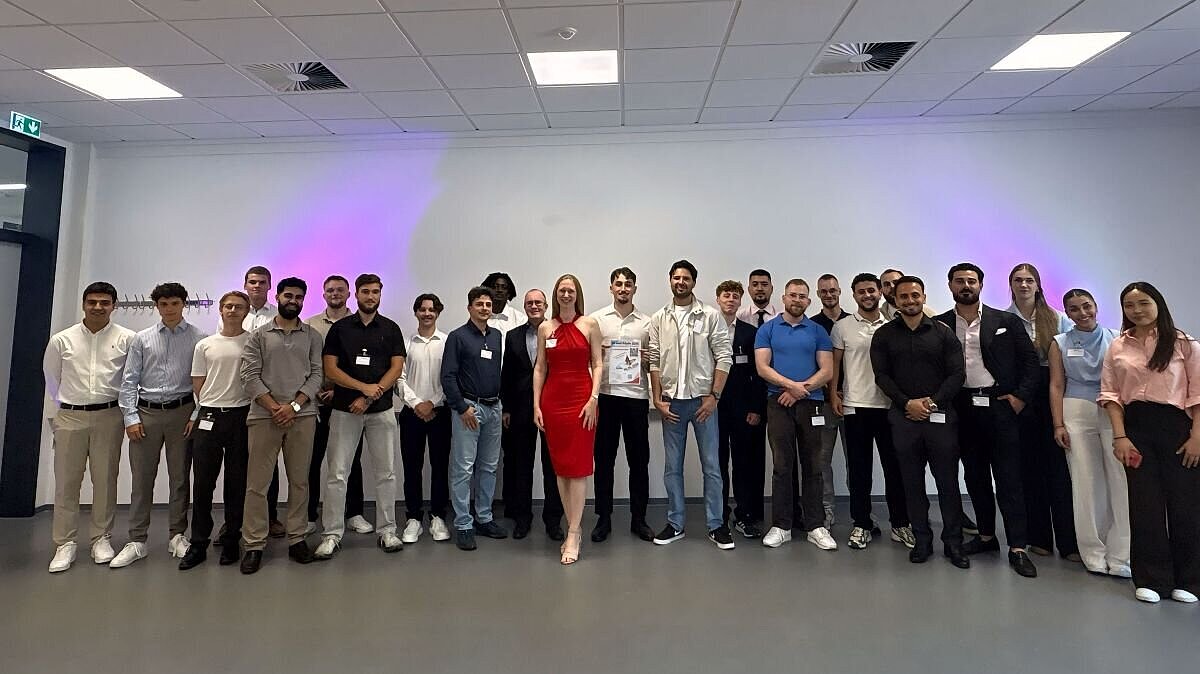
On June 6, 2026, the “AI and Minds 2026 – Work and Leadership in the AI Revolution” conference took place at the Rüsselsheim Campus of Hochschule RheinMain – University of Applied Sciences and Arts. About 100 participants from academia, business, politics, and higher education gathered to discuss current developments in the field of artificial intelligence and their impact on the world of work, education, and society.
The event was organized under the direction of Maria Wiesmann in collaboration with dedicated students and offered participants a varied program of expert presentations, panel discussions, and networking opportunities.
After everyone had arrived and exchanged initial greetings, the mayor of Rüsselsheim, Murat Karakaya, opened the conference with a welcome address. Prof. Dr. Peter Dannenmann, Associate Dean of the Faculty of Engineering, then welcomed the participants on behalf of Hochschule RheinMain – University of Applied Sciences and Arts and emphasized the importance of dialogue between academia, business, and society in the context of digital transformation.
Panel Discussion on the Changing World of Work
A particular highlight of the event was the panel discussion titled “AI and People—The Changing World of Work.” Mayor Murat Karakaya, Prof. Dr. Yassen Assenov, CZS Endowed Professor of Artificial Intelligence at Koblenz University of Applied Sciences, Dennis Örer, founder and CEO of socy.ai, and Dr.-Ing. Dirk Rensink, Group Leader at SEGULA Technologies Services, discussed the impact of artificial intelligence on businesses, educational institutions, and the labor market.
The discussion focused on questions regarding future skill requirements, the opportunities presented by new technologies, and the responsibility of politics, academia, and business in shaping the digital transformation. The diverse perspectives of the panelists led to a multifaceted exchange and generated great interest among the audience.
Another highlight of the program was the presentation by Dennis Örer. Under the title “My Journey as a Founder in the AI Business,” he spoke about his entrepreneurial career and provided practical insights into the development of AI-based business models. In doing so, he highlighted the opportunities that modern AI technologies already offer today and the challenges companies must overcome when implementing them.
Specialized Presentations from Academia and Practical Experience
As the conference continued, the topic of artificial intelligence was examined from various perspectives. In his presentation “What AI Can Do—and What Humans Must Be Able to Do,” Dr.-Ing. Dirk Rensink discussed the strengths and limitations of modern AI systems as well as the role of human skills in an increasingly digitized workplace.
An international perspective on the future of work was provided by the online presentation from Dr. Bijan Khosravani, a freelance senior executive consultant, on the topic “AI & the Future of Work.”
In her presentation “AI in Practical Experience: From Experimentation to a Shift in Thinking,” Sabrina Schmitt, a representative of Stadtwerke Rüsselsheim, demonstrated how companies can successfully integrate AI applications into their workflows.
In his presentation “AI in Studies & Everyday Work Life—Opportunities, Risks, and Reality,” Elias Allach provided practical insights into working with AI in educational and professional contexts.
Leo Bäumlisberger concluded the series of expert presentations with his talk “Better Prompting: How to Get Good Answers from AI,” in which he shared practical strategies for the effective use of generative AI systems.
Networking and Outlook
In addition to the expert presentations, the conference offered numerous opportunities for personal exchange. Participants used the breaks and the concluding networking session to make connections, share experiences, and gain new perspectives on the future of work and leadership in the AI era.
The “AI and Minds 2026” Future Conference impressively demonstrated the high level of interest in the topics of artificial intelligence, digitalization, and the future of work. The positive feedback from the approximately 100 participants underscored the importance of an open dialogue between academia, business, and politics to jointly shape the opportunities and challenges of technological transformation.
Special thanks go to all the speakers, guests, and supporters, as well as the numerous students and volunteers whose dedication contributed to the event’s success.
The successful execution of “AI and Minds 2026” also laid the foundation for a new event format. The Future Conference is set to take place annually and will continue to foster dialogue between academia, business, politics, and society on current future-oriented topics in the years to come.
Those interested can find additional impressions, photos, and highlights from the event on the official “AI and Minds” social media channels on Instagram and LinkedIn. In addition to impressions and recaps of the conference, future information and news about the event format will also be published there.