Self-conception of teaching and learning
The "Self-conception of teaching and learning" complements the general mission statement of the Hochschule RheinMain – University of Applied Sciences and Arts (HSRM). It clarifies the self-image and commitment of its members with regard to good teaching and learning as one of the university's central tasks.
The HSRM stands for very good, up-to-date academic teaching with a high degree of practical relevance (this also includes artistic teaching/qualifications in the following). Topicality refers not only to subject-specific topicality or relevance with regard to research, but also to didactic approaches.
Academic teaching is research-based, promotes critical discourse and analytical skills, as well as enabling students to independently develop solutions to problems in order to stimulate science-based, sustainable and reflective learning processes. In this sense, a comprehensive concept of education is used.
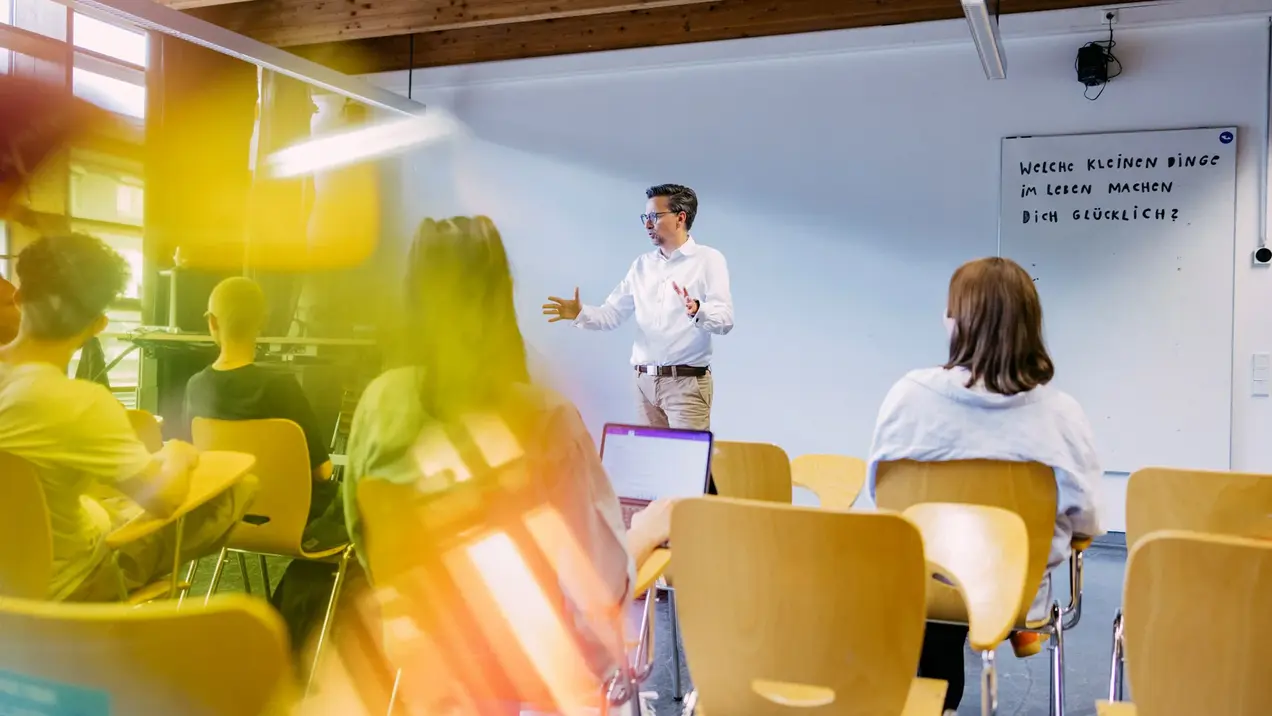
The university also values a variety of teaching and learning formats, which are also supported by digital formats in accordance with the goals pursued. The use of media serves to make teaching and learning more flexible and support it; nevertheless, the focus remains on presence-oriented teaching formats in the sense of a common culture of learning and discourse. Modern teaching and degree programs require appropriate equipment. The university provides resources for this.
Our courses are divided into contemporary bachelor's and master's degree programs. In research-intensive areas, independent doctorates and cooperative doctorates also enable further qualification at this level. Our Bachelor's degree programs ensure a broad, practice-oriented academic education and offer students an initial academic or artistic qualification. The master's degree programs are more research- and method-oriented and deepen or broaden the academic, professional and artistic qualifications. The university imparts the rules of good scientific practice at all levels.
At the university, learning goals, learning processes and examinations are coordinated with each other as key didactic measures (constructive alignment).
With the goal of didactic topicality and excellence, our teaching staff are committed to continuing education. This also includes the use of digital media and innovative teaching/learning methods.
The university provides sufficient suitable courses.
Teaching staff and students are jointly responsible for the success of teaching and learning. They see themselves as partners who cooperate in the learning process. The teaching staff see themselves as a team in the planning and implementation of the degree programs. They enable students to develop professionally, develop their personality and assume social responsibility. Students bear equal responsibility for successful studies, for example through their willingness to be an active member of staff in courses, their preparation and follow-up work and constructive feedback.
When planning their studies, students allow for appropriate time resources and, where possible, align their work with their studies. The HSRM attaches great importance to the personal support of students and, when designing the curriculum, pays attention to the appropriate workload associated with the goals, but also to appropriate freedom for independent study. We specifically address conflicts in the context of teaching and the corresponding framework conditions and deal with them constructively in discourse and in joint responsibility for good teaching.
We focus our teaching on students and their needs and promote talent.
The HSRM imparts knowledge within and across disciplines. Students learn to orientate themselves, communicate and develop within the disciplines as well as inter- and transdisciplinarily and internationally (see internationalization strategy of Hochschule RheinMain).
Graduates of our university are prepared for their diverse careers and changing professional fields through academic education.
During their time at our institution, the university's support measures are geared towards the different phases of our students' academic lives (student life cycle) and offer them tailor-made services.
Hochschule RheinMain – University of Applied Sciences and Arts attaches great importance to quality assurance and quality development in the area of Studies and Teaching and is constantly developing its internal quality assurance system.
The university pursues a feedback and discourse approach. It uses standard evaluation tools to determine student and lecturer satisfaction. In addition, there is a dialog-oriented feedback management system that can also provide indications of strengths and weaknesses in teaching.
The evidence-based results are incorporated into the optimization of structures and curricula in the sense of a closed quality control loop.
A handout has been developed to substantiate the central statements of the self-image and to support teaching staff and degree programs in their implementation. It offers practical recommendations for the design of courses and curricula.