Microsystems are essential components of sensors. They are used in medical and mobility technology, cybersecurity and communications technology as well as for networked production processes. But they also play an increasingly important role in the energy transition. Scientists at the Rüsselsheim Campus of Hochschule RheinMain – University of Applied Sciences and Arts (HSRM) are currently developing a platform for the micro-nano integration of novel sensor elements. In the coming years, they will work with GSI Helmholtzzentrum für Schwerionenforschung in Darmstadt and Archigas GmbH in Rüsselsheim am Main to integrate nanostructures into microsystems. This is expected to enable significant advances in hydrogen and infrared detection. The newly opened “eLine” electron beam lithography facility, which is being funded by the Federal Ministry of Research, Technology and Space with €1.65 million, is central to this project.
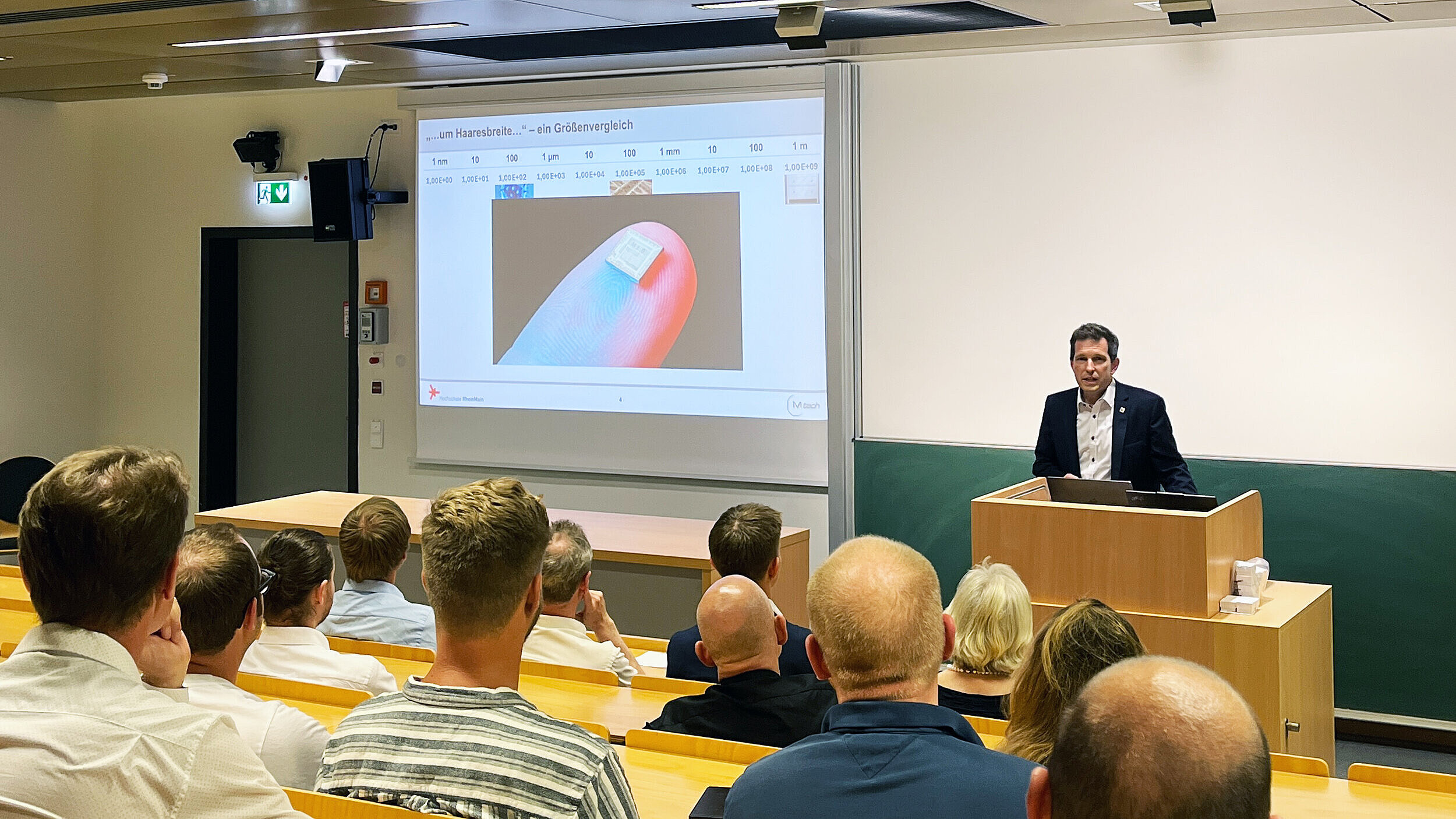
Currently, physicists and engineers at HSRM are primarily developing microsystems known as micro-electromechanical systems (MEMS) as pressure sensors for process measurement technology or micro-optical elements for processing materials. These systems contain microscopic structures measuring just a few micrometers (thousandths of a millimeter). “Incorporating what are known as nanostructures into these microsystems presents an entirely new challenge. These nanostructures have dimensions of less than one-thousandth of the diameter of a human hair,” explains project lead Prof. Dr. Markus Bender. “Using nanostructures in electronic components leads to higher integration densities – that is, more components in a smaller area – and greater computing power within the same space. However, integrating nanostructures that have been produced separately into sensors can give rise to entirely new physical effects, such as higher sensitivity, faster response times, and multifunctionality. The main aims of our research project are therefore to integrate nanostructures into microsystems as well as to develop safe and reproducible processing and handling methods.”
New nanostructuring equipment at the Rüsselsheim Campus
As part of the research project, the “eLine” electron beam lithography system has now been installed and officially inaugurated at the Rüsselsheim Campus. “This platform allows us to generate the nanostructures that are so crucial to sensor development. Hardly any other university of applied sciences in Germany possesses a device like this that enables the generation and manipulation of structures in the sub-10 nanometer range,” says Professor Bender.
Hydrogen and infrared sensors for the energy transition
“With this, we are producing sensor prototypes that can be used to detect hydrogen and identify infrared signals, among other applications,” adds Prof. Dr Hans-Dieter Bauer. Specifically, HSRM is aiming to develop two types of sensors for the selective measurement of hydrogen, along with an infrared sensor. The former are used to monitor the hydrogen supply chain, from production through distribution and storage to its conversion into energy in fuel cells. For their part, infrared sensors convert radiant energy from the infrared spectrum into electrical energy and ultimately into an electrical signal.
The project will focus on producing efficient infrared sensors from a non-toxic and affordable material. This has not been possible to date due to the lack of suitable raw materials and appropriate handling methods. “In this project, we use advanced techniques such as the femtosecond-laser structured hyperdoping of silicon to achieve the required electronic properties in the microsystems and thus also in future sensors. In infrared sensors, this energy conversion can also be used for highly efficient solar cells. This makes these sensors hugely significant in the ongoing transition to environmentally friendly energy sources,” explains Prof. Dr. Stefan Kontermann, an expert in ultrashort pulse lasers at HSRM. He intends to use rapid, affordable processing methods to modify the silicon base material and enhance its electronic properties by irradiating it with laser pulses.
Manifold possible applications
Overall, the intended results are expected to enable the production of more sensitive, more compact, and more affordable sensors and thus yield significant economic potential. The aim with the establishment of micro-nano interfacing (MNI) is to link nanostructures to the macroscopic world, enabling their functionality beyond laboratory and prototype environments. “The MNI technology has manifold possible applications in gas measurement and specifically in hydrogen detection as well as in applications in the fields of medicine, biotechnology, the Internet of Things, and much more,” tells Professor Markus Bender. The market opportunities are considerable, with the projected growth rates estimated to be in the double-digit percentage range.
Ongoing transfer between academia and industry
“I am delighted about this cooperative research project in a field that is of considerable economic and social relevance. Close collaboration with the GSI Helmholtzzentrum and Archigas GmbH will also support the successful transfer of technology between academia and industry,” said HSRM’s President Prof. Dr. Eva Waller. The cooperation can help maximize market developments and economic benefits: “If the project is successful, it could help drive innovation, especially in sensor and environmental technology, and open up new markets for compact, highly sensitive sensor solutions,” says Professor Bender. Professor Bauer adds: “More generally, the project will show how basic research, which is often considered far removed from practical applications, can drive developments and address industry needs.”
The research project is officially entitled “Micro-Nano Interfacing for MEMS-Integrated Sensing (MINIMISE)” and is being funded by the Federal Ministry of Research, Technology and Space as part of the FH-Kooperativ 2-2023 program (ref.: 13FH615KX2) with a budget of €1.65 million. Most of the professors mentioned are teachers within HSRM’s Applied Physics program. Students will also participate in the project, according to the concept of ‘learning by doing’.
[AI was used as an aid in drafting of the original German text; the English translation was completed by a human.]