UltraLIMO
| Project name: | UltraLIMO – Ultrashort-pulse laser material functionalisation for innovative micro-optical components |
| Department: | Engineering – Applied Physics |
| Project lead: | Prof. Dr. rer. nat. Stefan Kontermann |
| Project participants: | |
| Project partners: | |
| Duration: | 01.07.2017 – 30.06.2019 |
| Funding body or client: | Federal Ministry of Education and Research (BMBF), FHInvest 2016 |

Project description
Ultrashort pulse (USP) laser technology enables flexible, fast, customised and automated manufacturing processes. These are used for the micro-functionalisation of optical media, layers and silicon, with which the UltraLIMO project at the Institute of Microtechnologies (IMtech) of RheinMain University of Applied Sciences realises innovative component designs for combined applications in micro-optics, photonics and microsystems technology. They are important components for the automated value-creation process addressed by Industry 4.0, which IMtech implements industrially together with its project partners.
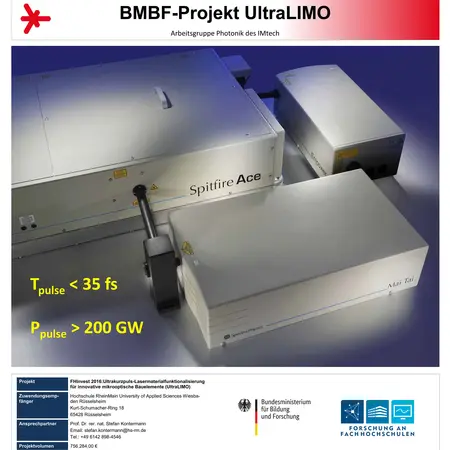
At the heart of the project is an ultrashort pulse laser system with pulse durations below 35 fs and peak pulse powers above 200 GW.
Project partners and tasks
- Topag Lasertechnik GmbH, Darmstadt: diffractive optical elements
- Polyscale GmbH, Aachen: light-guiding microstructures in plastics
- Fela GmbH, Villingen-Schwenningen: illuminated transparent touch displays
- Spittler Lichttechnik GmbH, Goslar: transparent light panels
- Unique Lights GmbH, Bad Lauterberg: transparent LED luminaires
- Clausthal University of Technology: absorption measurements, laser technology
- University of Western Ontario, London (Canada): coupling gratings for diffractive optical elements
- Optence e.V. – Competence Network Optical Technologies, Wörrstadt: networking with industry and the public in the field of photonics
Funding
UltraLIMO was funded by the German Federal Ministry of Education and Research (BMBF) under the measure “Funding of strategic investments at universities of applied sciences” (FHInvest 2016). The measure supports universities of applied sciences that expand their research profile or a research focus through investments in research equipment, facilities or demonstrators. This makes training of highly qualified, research-oriented specialists more attractive, improves research cooperation – especially with small and medium-sized enterprises – and increases the competitiveness of the universities.