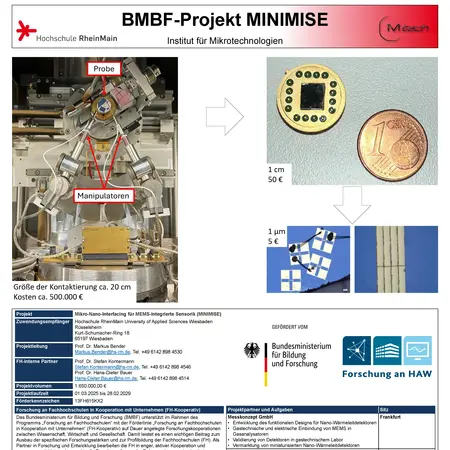
MINIMISE
| Project name: | MINIMISE – Micro-nano interfacing for MEMS-integrated sensors |
| Department: | Engineering – Applied Physics |
| Project lead: | Prof. Dr. Markus Bender |
| Project participants: | Prof. Dr. Stefan Kontermann, HSRM |
| Project partners: | Archigas GmbH, GSI |
| Duration: | 01.03.2025 – 28.02.2029 |
| Funding body or client: | Federal Ministry of Education and Research (BMBF), Research at Universities of Applied Sciences (HAW) |
Project description
The aim of the project is the reproducible integration of nanostructures into microsystems for sensor applications. To date, nanostructures in the form of wires and cones, as well as direct-written 2D or 3D structures, have only been produced as individual pieces to investigate fundamental questions. For ion-track-templated nanowires and nanowire networks and for fs-laser-processed hyperdoped silicon cones (fs-hSi), the fabrication process is well established and their physical properties have largely been studied – their integration into sensors, however, has not.
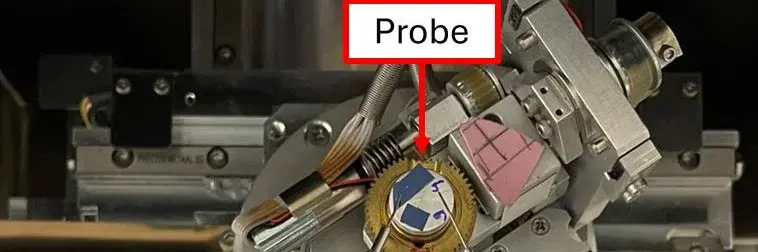
To bring these structures into applications, micro-nano interfacing (MNI) must be established, i.e. connecting nanostructures to the macro world via microsystems. Accessing specific measurands of a nanosystem requires a reliable and reproducible connection between microscopic and nanoscale systems. To this end, platforms are being created that allow the response of the structures to the corresponding stimuli to be measured reliably.
Application potential
MNI technology has considerable application potential in gas sensing (especially hydrogen), medical and biotechnology, the IoT and many other fields. As nanosensors are still far from industrial use, the project lies between market pull and technology push. A successful MNI technology can drive innovation in the energy transition and sustainability, biomedical applications and lab-on-chip, and possibly in quantum sensing.
Project partners and tasks
- Messkonzept GmbH, Frankfurt: functional design of nano thermal conductivity detectors, gas and electrical integration of MEMS into gas analysers, validation of the detectors in a gas laboratory, marketing of miniaturised nano thermal conductivity detectors
- GSI Helmholtzzentrum für Schwerionenforschung GmbH, Darmstadt: fabrication and characterisation of nanowires and nanowire networks, technology transfer of the nanowires to the application partner
Funding
The project is funded by the German Federal Ministry of Education and Research (BMBF) within the programme “Forschung an Fachhochschulen” in the funding line “FH-Kooperativ” (research at universities of applied sciences in cooperation with companies). This funding line supports long-term research cooperation between science, industry and society and strengthens the research infrastructure of universities of applied sciences through strategic and project-specific investments.